
At $608, the Minerva Long Dress costs roughly what you’d spend on two mid-range linen pieces from Witchery — or about half the entry price for a comparable Resort 2026 maxi from Zimmermann. That positioning, hovering between accessible contemporary and full luxury, is exactly where Charo Ruiz Ibiza has carved out its niche since launching in the early 2000s. The Spanish label, rooted in Ibiza’s bohemian holiday culture, specialises in white broderie anglaise, eyelet embroidery, and airy cotton pieces designed to look expensive without requiring a mortgage. Most dresses land between $550 and $1,009, with an average around $781 — expensive enough to feel special, accessible enough to justify for a single summer event.
What separates Charo Ruiz from the dozens of other resort brands flooding Australian summer? It’s not innovation — these are classic silhouettes repeated season after season. It’s consistency. The brand does one thing exceptionally well: refined, feminine, handcrafted-looking dresses in white, ivory, and soft pastels. If you’ve ever searched “white summer dress that doesn’t look like a nightgown,” this is the answer.
Where the Brand Started (and Why It Stayed)


Charo Ruiz Ibiza began in the early 2000s as a small atelier specialising in Ibicencan Adlib fashion — the island’s traditional embroidered cotton garments worn by locals since the 1970s. The aesthetic was always tied to vacation: breezy, romantic, impractical for daily life but perfect for long lunches overlooking the Mediterranean. The brand scaled without losing that core identity, which is rare. Pieces still feature hand-guided broderie anglaise, scalloped hems, and ladder lace inserts — techniques that require slower production than digitally printed rivals.
Crucially, Charo Ruiz avoided the trap of over-expansion. There are no leather goods, no denim, no activewear capsules. The focus remains entirely on dresses, with occasional cotton tops and skirts. That discipline means the quality baseline stays high. A $711 dress in 2026 uses the same eyelet embroidery techniques as a $650 dress did in 2018 — there’s been no quiet shift to cheaper digital embroidery or fused appliqué.
What $550–$1,009 Actually Buys You
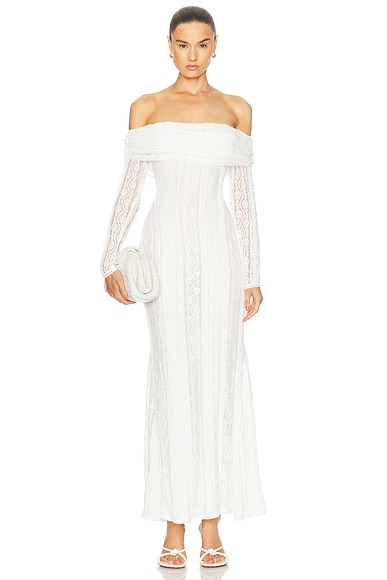
The Minerva Long Dress at $608 is the brand’s entry-level maxi — full-length, tiered cotton with ladder lace inserts and a deep V-neckline. It’s basic in the best sense: no fussy straps, no asymmetric hems, no styling gimmicks. The construction relies on natural cotton (not a poly blend), French seams, and hand-guided embroidery around the bodice. Compared to similarly priced resort pieces from Bec + Bridge ($400–$600), the fabrication feels noticeably softer and less synthetic. Compared to Zimmermann’s broderie anglaise maxis ($900–$1,400), the silhouettes are simpler but the price difference is substantial.
The Catta Dress at $853 represents the brand’s mid-tier: a knee-length style with allover eyelet embroidery, bishop sleeves, and a tiered skirt. Here, the price reflects density of detail — the entire bodice and sleeves are covered in hand-guided cutwork, not just strategic panels. The ivory colorway leans bridal without crossing into costume territory, making it a frequent choice for engagement parties and beachside ceremonies.

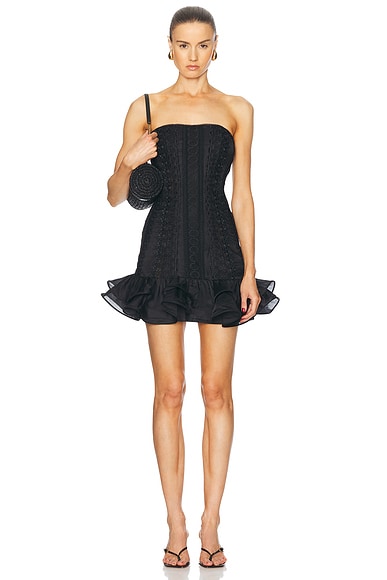
At the top end, the Sunil Short Dress at $1,009 features black floral embroidery on sheer tulle, lined with cotton voile. This is the brand at its most detailed: multi-layer construction, contrast thread embroidery, and scalloped edges that require individual finishing. It’s also the closest Charo Ruiz gets to evening wear — most pieces skew daytime and resort.
The Design Language: Predictable, But That’s the Point
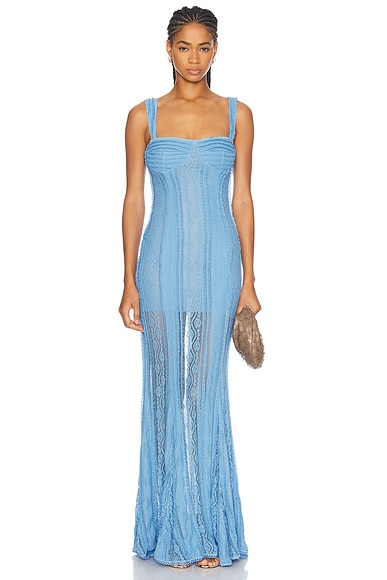
Every collection follows the same formula: white or ivory base, broderie anglaise or eyelet embroidery, tiered or A-line silhouettes, natural cotton fabrication. There are occasional detours into pale blue (the Blossel Dress) or dusty pink (the Danny Long Dress), but the core is relentlessly neutral. That repetition isn’t laziness — it’s brand discipline. Customers return season after season knowing exactly what they’ll get, which is particularly valuable for milestone events. Need a white dress for a Greek island holiday? Charo Ruiz has 12 options. Need something experimental or trend-driven? Look elsewhere.

The silhouettes tend to run relaxed through the body with defined waists — empire seams, drawstring ties, or smocked bodices. The Pralle Short Dress at $711 uses a high-waisted gathered skirt with a fitted bodice, creating an elongated torso without relying on stretch fabrics. It’s a forgiving cut for anyone between a size 8 and 14, though taller frames (170cm+) may find the “short dress” classification hits closer to midi length.
Fit Notes: What Works and What Doesn’t
Sizing runs true to European standards, which means Australian customers typically size up once. A marked size 38 fits like a local size 10, not a 12. The cotton has minimal stretch, so if measurements fall between sizes, the larger option is safer. The Gaia Long Dress at $773, for example, has a fixed waist tie — there’s no elastic or adjustable smocking, so the waist circumference is locked.
Bust fit skews narrow. Several styles (Catta, Pralle, Gardenia) use a structured bodice with no give, which works beautifully for A–B cups but can pull or gap on larger busts. The Giulia Dress at $642, with its loose empire waist, offers more flexibility. Straps are generally fixed-length, not adjustable, so petite frames under 160cm may need alterations to avoid excess fabric pooling at the neckline.
Length is generous — most “short” dresses hit mid-calf on a 165cm frame, and maxis graze the floor even in flats. That works well for the brand’s romantic aesthetic but can overwhelm smaller proportions. Hemming is straightforward (the tiers are separate panels), though it will reduce the volume of the skirt.
Worth Noting: Where to Set Expectations
These are holiday pieces, not everyday workhorses. The cotton is soft and breathable but prone to wrinkling — expect to steam before wear. The white and ivory colorways require careful handling; broderie anglaise is difficult to spot-treat without damaging the embroidery. Dry cleaning is recommended for anything with heavy cutwork or multi-layer construction, which adds to the cost-per-wear calculation.
Durability is high for occasional use, moderate for frequent rotation. The embroidery holds up well — no fraying or loose threads after multiple wears — but the cotton itself can thin over time, especially around high-friction areas like underarms and waistbands. This isn’t fast fashion construction, but it’s also not heirloom-grade. A dress worn 10–15 times per summer will likely show wear within two seasons.
Best Pieces to Start With
The Minerva Long Dress at $608 offers the strongest entry point — full-length, classic silhouette, minimal fuss. It’s the dress you wear to a beach wedding, then again for a summer dinner, then again for a holiday in Tuscany. The ladder lace inserts add visual interest without requiring excessive embroidery, keeping the price point lower than heavily detailed styles.
The Iraso Dress at $550 (marked down from $916) is the brand’s most accessible piece — a simple tiered midi in white cotton with minimal embroidery. It’s not the showstopper of the collection, but it’s the dress you’ll actually wear multiple times, which improves the cost-per-wear calculation significantly.
For maximum impact, the Catta Dress at $853 delivers the full Charo Ruiz experience — allover eyelet embroidery, romantic bishop sleeves, and a silhouette that photographs beautifully. It’s the piece that justifies the price tag, assuming you have a specific event in mind. Buying this for “maybe someday” is a expensive gamble.
The Faithful Reform or Spell & The Gypsy Collective Customer
Charo Ruiz sits in a narrow lane: more refined than Spell’s boho maximalism, less structured than Faithfull The Brand’s tailored resort pieces, and significantly more expensive than both. A comparable broderie anglaise maxi from Faithfull runs $350–$450 — about 60% of Charo Ruiz’s price — but uses machine embroidery and lighter-weight cotton. Spell’s white dresses land around $300–$500, with a looser, more vintage-inspired fit.
The customer who gravitates toward Charo Ruiz typically wants something a step more polished than Spell but doesn’t need the editorial edge of Zimmermann. It’s the dress for someone who values craftsmanship but isn’t chasing trends. If you own multiple pieces from Matteau, Sir the Label, or Bondi Born, Charo Ruiz will feel like a natural fit. If your wardrobe leans Bec + Bridge or Camilla and Marc, the aesthetic may feel too soft.
When to Skip and Shop Elsewhere
If you need versatility, Charo Ruiz isn’t the answer. These are single-occasion pieces — the white broderie anglaise dress you wear once or twice per season, not the five-day-a-week rotation staple. For that budget, brands like Jac + Jack or Bassike offer neutral linen and cotton basics with higher cost-per-wear value.
Petite frames under 160cm may struggle with proportions. The long, loose silhouettes can overwhelm smaller builds, and alterations reduce the impact of tiered skirts. Sir the Label offers more fitted, tailored options in the same price range that work better for compact proportions.
Anyone after bold prints, saturated color, or architectural silhouettes should look to brands like Camilla or Nicholas. Charo Ruiz’s palette rarely ventures beyond ivory, white, pale blue, and blush pink — it’s a deliberately narrow range designed for a specific aesthetic.

Is $781 (Average) Worth It for a Cotton Dress?
The value equation depends entirely on usage. If you’re buying for a specific event — a destination wedding, an engagement party, a milestone birthday — and you’ll wear it 3–5 times over two summers, the cost-per-wear lands around $150–$260. That’s steep but defensible for a piece that requires hand-guided embroidery and natural fabrication.
If you’re buying because it’s beautiful but don’t have a clear plan for when you’ll wear it, the value drops sharply. A $853 white dress that sits in your wardrobe for 18 months before its first outing is a poor investment, regardless of craftsmanship.
The brand’s strength is consistency. You’re paying for a specific aesthetic executed at a reliable quality level, season after season. That predictability has value — especially for milestone events where you need to know exactly what you’re getting. But it also means there’s little innovation or evolution. If you bought a Charo Ruiz dress in 2022, the 2026 collection will feel familiar, possibly redundant.
For the customer who values romance, natural fibers, and hand-finished details, Charo Ruiz delivers exactly what it promises at a price point that sits comfortably between contemporary and luxury. For anyone seeking versatility, trend-driven design, or everyday practicality, that $550–$1,009 is better spent elsewhere.
💌 Get the Weekly Style Edit
Curated fashion picks, new brand alerts, and sale notifications. Delivered every Wednesday.
Liked this?
Read our Spring 2026 Style Report — then get picks like these every Thursday from 800+ brands.
Join The Edit →